The Benefits of a Covered Drive

The Benefits of a Covered Drive 10

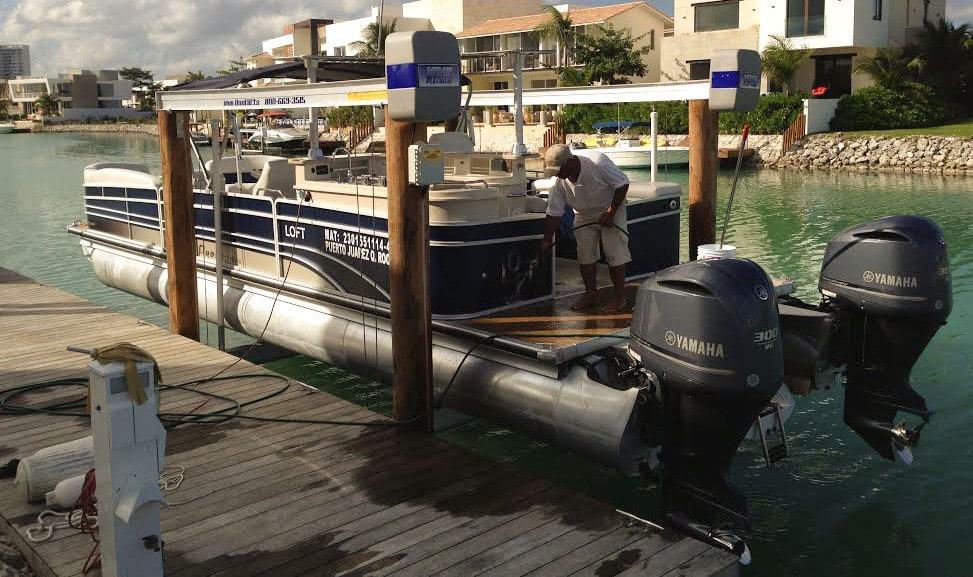
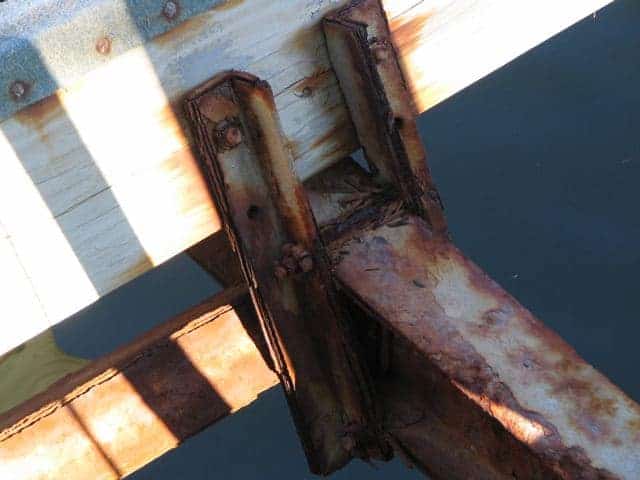
There can be little doubt that Mother Nature will ruin machinery if it is not protected properly. A marine environment is particularly harsh and most people realize how damaging corrosion and electrolysis can be to boats. However, few realize just how vulnerable boat lift drive systems are to environmental degradation. The drive system components that are most vulnerable are the motors, gearboxes and the moving parts (e.g. sprockets, chains, belts, etc.). Let’s take a look at what can happen to unprotected drive systems, especially the motors.

General Benefits of a Cover

IMM Quality Boat Lift Cover
IMM Quality Cover

The IMM Quality Boat Lifts covers have been specially designed to protect and preserve the drive components. The covers are made from high-density polyethylene to provide chemical, U.V. and corrosion resistance. The U.V. protection will minimize fading, sun damage and reflect heat from the sun to lower the surface temperature of the drive components, thus protecting the motors from overheating. We use a roto-molding process to make the covers extra thick to provide the highest level of impact resistance and durability. They will protect your drive components from rocks, lures, limbs, aerial assaults from birds, sea salt, and the elements while keeping everything looking new.

Harsh marine environment quickly ruins uncovered drive components

boat lift drives over time

The covers also protect the drive components from grime and grit.  The housing of the gear boxes are made from cast aluminum so exposure to the elements simply affects the cosmetic appearance.  However, the drive shaft from the gearbox is made from carbon steel so that it can withstand the torque.  This drive shaft along with its seals is vulnerable to breaking down in a marine environment and protecting them with a cover greatly extends the life of the gearbox.  In addition, the sprockets and many other drive components require lubrication to allow them to turn easily and to protect them from corrosion.

grit on boat lift motor
How much grit is on the inside of the motor? This much.

Open drive systems allow the weather to wash away the lubrication, necessitating more frequent maintenance with re-application of lubricant, otherwise, the moving parts will make loud noises and will eventually bind.  Open drive systems also allow grit to accumulate on the components which will wear down the sprockets, sheaves and other moving parts much more quickly than when they are protected by a cover.  With all this grime and grit it is a good thing that the IMM Quality covers were designed to be simple to clean using just a mild detergent and water.

Motors

There are many kinds of motors, but the types most commonly used by boat lift manufacturers are open drip proof (ODP), totally enclosed (either non-ventilated (TENV) or fan cooled (TEFC)), stainless steel and extreme duty washdown motors.

Extreme Duty Washdown MotorIf you can afford it, an extreme duty washdown motor is the absolute best choice for a boat lift.  All exterior components are made of stainless steel, along with weather resistant seals and all the other internal components are engineered to resist environmental contamination and corrosion.  As the name suggests, these motors are designed to be washed down with a hose while they are running.  The only real problem is that they cost four times more than a good TEFC motor.  Most consumers cannot justify spending thousands of dollars more on their boat lift for these premium motors.

ODP motorsODP motors are just that – completely open to the environment.  It’s like an open door from whatever is outside, to your bearings, windings and other components on the inside.  Dirt, soot, rain, ocean spray, etc., it all gets inside.  Wildlife and insects are especially fond of nesting inside these motors (mud daubers really love them).  These are the cheapest kind of motor on the market and they do not use weather resistant components.  ODP motors are often used on cheap flat plate drives and are a terrible choice if the drive system is not protected by a well-sealed cover.

TENV and TEFC motorsTENV and TEFC are very similar in design.  Although both of these motors are sealed, the gaskets and other materials are not designed to withstand direct exposure to an outside environment.  The main difference between TENV and TEFC is the fan cooling.  Motors get hot while running and the fan cooling extends the continuous runtime before the motor will overheat.  Typically the non-ventilated TENV motors have rated runtimes of 15 minutes, while the fan-cooled TEFC motors are rated as continuous duty (ie. they can be used continuously, 24 hours a day).  TEFC motors are a great, cost-effective choice when used under a cover.

Stainless Steel MotorsStainless steel motors are frequently used on boat lifts that do not have covers (most commonly TENV versions).  What you should keep in mind is that only the exterior housing, capacitor case, and conduit box cover are made from stainless steel.  The internal parts are not.  This is important because water condenses on the insides of non-covered motors as they cool after use.  Therefore, even stainless steel motors have drain plugs to allow the accumulated water to drip out.  So even though the outside of a stainless steel motor may look nice and rust free, the inside components are frequently ruined by the condensation.

The Benefits of a Covered Drive 9
Rusty windings, rotor and capacitor from inside an uncovered stainless steel motor

Using a cover essentially eliminates condensation inside a motor.  The cover greatly slows the cooling of the metal, the cover limits the volume of air around the motor and the cover limits the turnover of moist air around the motor by lowering air flow.  To help you understand why covers eliminate condensation, think about your car and how water can condense on it as dew or frost.  Then think about how cars parked inside garages are protected from this condensation.  Even though the garage is not air tight, is not insulated or heated, cars parked in garages do not get frost (in winter) or dew (in summer) on their windshields on the same night cars parked outside do have condensation.  The same scientific principles protect your boat lift drive components from condensation when they are covered.

Conclusion

There are many reasons why owning a boat lift that has a cover for the drive components is a wise idea.  Covering the drive components will protect them from the elements and greatly extend their service life.  A cover will also preserve the beauty of your motor and gearbox in addition to increasing the resale value of your lift.  A good cover improves the overall aesthetics of the lift giving a sleek, clean look compared to the clunky, industrial look of exposed machinery.  Given all the benefits of a covered drive, why would anyone choose to do otherwise?

Smart Boating: Combining Business with Pleasure

Smart Boating: Combining Business with Pleasure

For many people with salt in their blood, there is simply no experience like cutting through the waves on a bright and sunny day in their boat. Whether it’s fishing or skiing on an inland lake or running down the coast, the sense of freedom and independence is an experience that drives millions of boat owners.

Making Financial Sense

Investing in the perfect boat to ensure you have this opportunity is a big decision. However, there are ways to make that decision much easier. In fact, finding just the right boat may include thinking of it as a business expense.

If you are involved in any type of company or business where you entertain clients, your boat may provide some creative alternatives. You and your family enjoy your boat, and there are millions of others who don’t own boats who also enjoy that experience. Take this fact into consideration, and you just might end up with larger, more versatile choices for the boat you purchase.

There are a number of ways you can use a few smart financial insights to make your boat more affordable and to justify a larger one. Below are five tips that others use to make boat ownership easier to handle.

1. Business entertainment.

Taking prospects and clients out for a short spin or an enchanting sunset cruise is a great way to build and maintain profitable relationships. If you use your boat for this purpose, there are many deductions that you can utilize to lower your taxes. There are some special rules, but it is worth learning about them. You can deduct up to 50 percent of your expenses for each trip, including such things as food, drinks, fuel, mooring fees, and even tournament fees if you fish. Check with your tax professional for the details and start using that deduction.

2. Renting or leasing your boat.

It is easy to find individuals and firms that will rent your boat out to tourists or other short-term users. You will have to report this income, but there are often enough deductions to make this another way to save on taxes. With the ability to write-off depreciation, mooring costs, fuel, maintenance and other expenses, this offers a great alternative to just having the boat sitting in the slip. Again, any tax professional can help you understand the best way to use this financial strategy.

3. Declare your boat as a second home.

Many boat owners are surprised to discover they can deduct the interest on their boat payment under certain circumstances. There are some considerations to declaring your boat as a second home, but there is a totally legit basis for doing so. Your vessel must have a sleeping area, head, and facilities for cooking to serve as a second home. Also, you must stay on the boat at least 14 days a year, or, if it is also rented, at least 10 percent of the total days’ others pay to use it.

4. Deduct taxes.

Keep track of all your sales taxes and related expenses, or lease your boat. Depending on your state and income level, the taxes paid on purchasing your boat are deductible. Your tax advisor can also explain the potential advantages of leasing instead of buying your boat.

5. Donate your boat.

There are several different strategies for donating a boat. If you are simply getting rid of an old boat, you will normally be able to deduct the market value of a donation to a charity. On the other hand, if you aren’t using your boat regularly, you may find it worthwhile to donate the boat to a certain charity while arranging to use it periodically. You can take the full deduction and then pay the charity a market rate when you use it. If that use is for business, the payment is deductible as a business expense, as discussed above.

Take the time to visit with your tax professional and an experienced boat salesman. You can save on the costs of boat ownership and, perhaps, even justify a bigger boat to enjoy.

For questions about boat lifts, contact us.

How to Choose the Correct Capacity Boat Lift for your Boat

How to Choose the Correct Capacity Boat Lift for your Boat

Boat lift capacity

When it comes to choosing a lift for your boat, pontoon or PWC, there are a few things you will need to know to ensure you purchase a lift that is the proper size for your watercraft. Knowing the overall weight and beam of your boat is the best place to start. This will allow you to choose the correct weight capacity and the correct cradle width.

Finding the Overall Weight

When determining the overall weight of a watercraft, you will need to account for the dry weight of the watercraft, the fuel, gear, water and the weight of any non-factory additions. This will give you a more accurate weight, allowing you to choose the correct lift capacity.
  • The dry weight of a watercraft is usually provided in the brochure or specification sheet for the watercraft. Another great resource for this information is the online NADA guides (www.nadaguides.com/Boats). Please note, the dry weight provided often does not account for the weight of outboard motors.
  • Depending on the temperature, type, and blend, gasoline weighs approximately 6 lbs. per gallon (0.72 kg per liter). With this information and the capacity of your fuel tank, you can calculate how much a full tank of gas will add to your boat’s overall weight.
  • Water weighs approximately 8 lbs. per gallon (0.96 kg per liter). You should account for the capacity of your fresh water tanks, waste water tanks, and any live wells.
  • The weight of non-factory additions like wakeboard towers, bimini tops, additional seating, generators, air conditioning units, coolers and swim platforms should be added to the overall weight calculation.
  • Take a look at everything stored in your boat. Your gear like skis, wakeboards, scuba equipment, etc. should be added to the total weight of the watercraft.
Once you have found the overall weight of your watercraft, you can then determine the correct boat lift weight capacity needed for your watercraft. It is best to add in a 20% margin of safety and then select the next higher capacity for your lift. Why should you have a margin of safety? There are many things that can adversely impact the lifting capacity that you may not realize. For example, a boat lift’s capacity is calculated assuming the center of gravity of the watercraft has been perfectly centered on the cradles. If the overall weight is too close to the lift’s rated capacity and you place your bunks a little closer to the dock side or if you park too far forward or behind the center line, you can overstress one side or even a single corner of a lift. What if you forget to remove the drain plug and there is a heavy rain? How about a heavy snowfall that puts a couple of feet on top of your watercraft? What if you don’t realize that the bilge pump is malfunctioning and you are accumulating water? All of these things may result in a lift failure if you don’t include a safety margin when selecting the lift capacity. The point is that little things can add up and it is best to err on the side of caution.

Finding the Length of the Cradle Beam

You will then want to find the beam of your watercraft, which is basically the widest portion of your watercraft. The inside pile to inside pile width needed to park your watercraft on the lift should be the beam width of your watercraft plus at least a 4” cushion on both sides (this minimum distance situation presumes that you will have dock pile bumpers and use the piles as guides). If you plan to use guideposts on the lift for your boat, it is a good idea to give yourself at least a 10” to 12” cushion on both sides. Finally, you should remember that the lifting beams are centered on top of the piles so the lifting cables will be centered on the piles as well. Therefore, you need to account for the center of pile distance (to get the center of pile to center of pile distance, add one pile diameter to your running total). For example, if your boat had a beam width of 8’ 6”, you planned on using guide posts with a 12” cushion on both sides and the piles had a 10” diameter, the minimum length of your cradle beam would be 8’6” (beam) + 12” + 12” (cushion) + 10” (center of pile) = 11’4”.

Choosing the Right Sized Lift for your Boat

You should also consider the local water conditions. Most importantly, you need to know the water depth at low tide. Keep in mind that there is about a 12’ distance between piles, so it is a good idea to measure the water depth at both ends to ensure that you have enough depth to accommodate the draft of your watercraft so that you can float onto the bunks. The smallest lifts use 6” cradle beams, whereas the largest use 12” cradle beams, and sometimes every inch counts in low water conditions. Once you have all of your calculations in place, you should consult the lift manufacturer’s specification sheets. These documents should specify the lift capacities, recommended pile spacing and beam sizes for the various models of lifts. All of our lift specification sheets are available under the Documentation tab at our website, info@iqboatlifts.com. With these pieces of information, you should be able to determine the appropriate capacity lift for your boat. Or if you would rather have some guidance, please feel free to contact our sales staff at (800) 545-5603. In addition to our standard lift models found on our specification sheets, please keep in mind that IMM Quality Boat Lifts is the industry leading custom lift builder. Our engineers will be more than happy to design the perfectly sized lift to fit your individual needs.
Superlift boat lift by IMM Quality holds white and blue yacht

Frequently Asked Questions (FAQs) about Choosing the Correct Capacity of Your Boat Lifts:

To find the correct boat lift capacity, you need to know your boat's overall weight including dry weight, fuel, gear, water, and any non-factory additions. It's recommended to add a 20% margin of safety to this total weight.

The beam of your boat determines the width needed for the cradle on the boat lift. It's important to ensure there's enough space for your boat to be securely placed on the lift.

A margin of safety accounts for unforeseen factors that might affect the lift's capacity, such as imperfect centering of the boat, water accumulation, or additional weight from snow or gear.

You can calculate the total weight by adding the dry weight, the weight of fuel, water, gear, and any additions to the boat. There's also an easy calculator tool provided on the website for assistance.

Consider local water conditions like water depth at low tide and ensure there's enough depth to accommodate your boat's draft. Also, check the lift manufacturer's specifications for pile spacing and beam sizes.

Tips for Picking the Best Boat Lift

Tips for Picking the Best Boat Lift
Here’s a question: Off the top of your head, how much time, money and energy have you invested in your boat? If you’re like every other boat owner in history, the answer is, “a lot.” So why would you want anything but the best boat lift for your needs? The tricky part is figuring out what “best” means for you. And it is tricky. There are almost as many kinds of boat lifts as there are boats to be lifted. We can’t tell you what you need without knowing your exact situation. But we can give you some valuable tips to help and things to consider as you figure it out for yourself.

Consider the Boat

There are plenty of horror stories of boat owners who bought the wrong boat lift for their boat. Or who asked their lift to perform beyond its capacity. You can avoid a lot of those problems by considering the kind of lift and lift capacity that’s right for your boat. That means calculating the weight of your boat when it’s loaded with fuel, supplies, toys and accessories. And remember that the shape of your hull and its draft will help determine the lifting height you need, the minimum water depth and the bunks you’ll need on your boat lift.

Consider the Dock

There’s a lot to weigh here. For example, is your dock fixed or floating? Does it have notable erosion due to marine life or tides? And consider these factors: What are the physical dimensions of your slip? Can your dock structure support the installation of the boat lift you’re considering? If your dock has a roof, is it high enough for your boat when it’s raised high enough to clear the water? And is it strong enough to support both the suspended boat lift and your fully loaded boat? Is your slip deep enough to allow the lift you’re considering to lower the cradles enough to float your boat off the cradles? Are there obstructions in the slip that might interfere with lift operation? Is electricity available to your dock?

Consider the Water

Is your slip subject to rough water? If so, be sure to consider a lift high enough to clear the water in typical conditions. Is your slip subject to variations in water depth? If so, you may need a floating dock, or a custom design to satisfy your need.

Consider the Useful Life of the Boat Lift

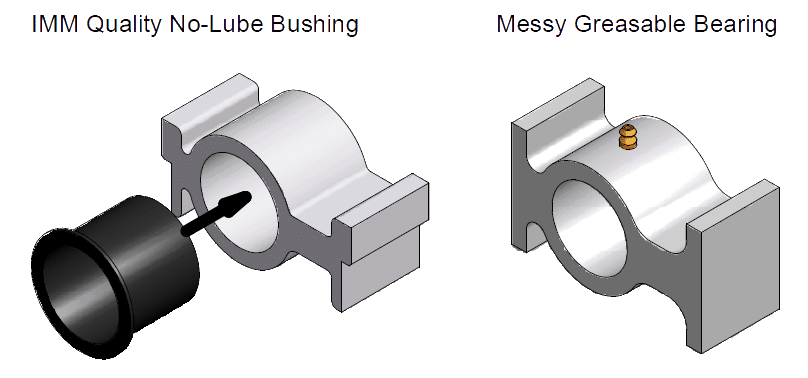
Nothing lasts forever. But some things last a lot longer than others. And some need a lot more maintenance than others. For example, what’s the boat lift you’re considering made of? Aluminum does not rust and is stronger and lighter than steel. How are the bearings and pulleys designed? Grease bearings and pulleys need expensive maintenance on a regular basis. And the black grease they use can leak, making a mess of your boat, dock and lift. Are you a DIY type or do you hire out your maintenance? If you DIY, do have some way to safely reach the outside top beam to inspect and lubricate its components? If any of these are a concern, you should consider a low-maintenance lift design.

Consider Your Specific Needs and Preferences

What kind of style of lift would you prefer? Standard top beam, elevator or beamless? Do you want a standard installation? Or would you prefer your top beams set high so that you walk under them? Or set your top beams low and use them as a step while boarding? How about a platform lift where the lifting cradle is covered in decking? Are you looking for a manual control lift or would you prefer remote lift controls that automatically stop the lift at the top, bottom and boarding height? Do you have custom design or accessory needs? Are you interested in a canopy, boarding platform, underwater lights or powder coating your lift to match any color? Are you the type of person that hates to stand around waiting on things? If so, you should consider the drive and how it affects the speed of the lift. For example, flat-plate drives, besides being incredibly noisy, are extremely slow. There you have it, a basic breakdown of what to consider when choosing a boat lift. However, if you still have questions or want a professional to evaluate your specific needs, please don’t hesitate to contact us.
red and white boat uses boathouse lift solution by IMM Quality

Press Release, March 24th 2017

IMM Quality Boat Lifts engineer inspects boat lift parts for sale

IMM Quality Boat Lifts Enters New Markets with Expanded Manufacturing Capabilities,  New Equipment, and Larger Fleet

Fort Myers, FL – IMM Quality Boat Lifts, the world’s largest and leading boat lift manufacturer, has recently updated and expanded their Fort Myers, Florida, facilities. The company’s main manufacturing facility now includes 34,000 square feet under roof to go with a further 30,000 square feet of exterior workspace. The secondary factory has completed its conversion to a modern 14,000 square foot dedicated testing and product development facility.

In addition to the expansions, the company has invested over $1,000,000 in new equipment and factory improvements. The new equipment the company has added include a second computer numerical control (CNC) router table, another CNC auto saw, CNC plasma cutter, AlumaFeed synergic dedicated aluminum welding systems and a drill center with sliding press on linear rails. A brand new primary air compressor system was added along with a new automated backup secondary air compressor system, so there is never any downtime with the CNC machines and air tools. The factory’s materials handling capabilities were expanded, and the materials storage facilities were modernized for better organization and computerized inventory control. Finally, the company has upgraded to the most modern engineering software, including computer-aided design (CAD) software, computer aided manufacturing (CAM) software to run the CNC machines and materials stress analysis testing software. These tremendous improvements allowed them to streamline the manufacturing process while keeping the reliability and quality they are well-known for.

They also added a whole new fleet of vehicles to expand delivery capabilities to their dealers.

“Over the past few years, home construction and the number of boat owners have both gone up,” said Steve Nanda, the company’s head of operations “and this has resulted in an increase in the number of IMM Quality Boat Lifts customers.” “We are grateful to our customers for enabling us to make significant leaps in the past few years,”

IMM Quality Boat Lifts has been manufacturing boat lifts since 1982. With increased capacity, they are growing nationally, but are also expanding into various international markets. Over the past few years, they have entered markets in Norway, Russia, India, and now Qatar, in each instance innovating to adapt to the local geography and conditions. In Qatar, a private marina has an eight feet by sixty feet floating dock connected to a fixed pier by floating gangway. IMM Quality Boat Lifts custom designed power heads and a lift system to raise the entire floating dock up the dock’s internal concrete reinforced steel pilings. Their in-house engineering department and custom design services allow them to build products for unusual circumstances and to meet the needs of demanding markets.

For examples of installations done in the USA and abroad, there are photos available on their website gallery.

The company manufactures boat lifts including vertical boat lifts, elevator lifts, specialty boat lifts, personal watercraft lifts, the Titan yacht lift and boat house lifts. IMM Quality has over 30,000 boat lifts in the field, and some of their original models are still in operation after 40 years.

For more information, please contact us.

Boat Lift Maintenance

White boat with navy covering is held above the water for Boat Lift Maintenance

The convenience of a boat lift can make any captains experience extra luxurious, but only if the lift is operable.  You need to perform regular maintenance on your boat lift to make sure it continues to work properly.  Proper maintenance will ensure that your lift performs as expected for many years to come.  Ignoring routine maintenance may damage your lift, resulting in difficult and costly repairs.  In this article, we will go over general boat lift maintenance suitable to any manufacturer as well as the maintenance procedures for the IMM Quality lineup of boat lifts.

Regular boat lift maintenance is important.


General Boat Lift Maintenance Procedures

Lift Cables – Make sure to inspect your lift cables regularly for any signs of wear and to see if they are winding properly.  Rust spots, broken strands, fraying, kinks and abnormalities are all signs that you may need to replace your cables.  If you notice any signs of wear, contact a professional marine contractor ASAP and have an expert inspect them to see if you need a cable replacement.

Every time you use the lift, it is important to make sure you wash the cables with fresh water after you have finished using the lift.  Saltwater will corrode the cables and dramatically reduce their lifespan if they are not rinsed off properly.

You may choose to lubricate your lift cables with a penetrating oil like Lubriplate’s Chain and Cable Fluid Penetrating Oil (Part No. L0135-063).  Individual strands inside the cable move and rub against one another during normal operation which causes abrasive wear on the inside and outside of the cable.   Penetrating chain and cable lubricants provide corrosion protection and lubrication to the core inside strands, the exterior surfaces and also wash off the external surfaces to remove contaminants and dirt.  Proper lubrication can greatly increase cable life.

Manufacturers of stainless steel cables recommend cable replacement after two years of normal use, even without signs of wear.  Failure to properly maintain your lift cables may cause a catastrophic failure resulting in damage to your lift and dock, damage to your boat and / or severe injury.  Please do not take chances over-extending the life of your cables.

Don't let this happen to you. Check your cables!
Don’t let this happen to you. Check your cables!


Lift Beams – Every time you use your lift you should rinse the lift beams with fresh water to rid them of any salt and any potential barnacle growth.  When lift beams are not cared for and rinsed routinely, the salt and barnacles build up, causing the beams to corrode and weaken at a much faster rate.  The best way to reduce wear from salt water, barnacle growth and electrolysis is to keep your lift beams out of the water as much as possible when not in use.


Don't forget to wash your cables and cradle beams too.
Don’t forget to wash your cables and cradle beams too.


Bunks – Make sure to regularly check the bunks for any tears or worn out areas in the carpet.  Also examine the wood for broken, cracked or rotted areas.  Examine the bunk brackets for cracks and signs of wear.  Adjust the position of the bunk brackets, if necessary, and make sure all hardware is tightened.  Due to their frequent use and exposure to water, your carpeted wood bunks will need periodic replacing.

Cracked bunks and rusty galvanized cradles.


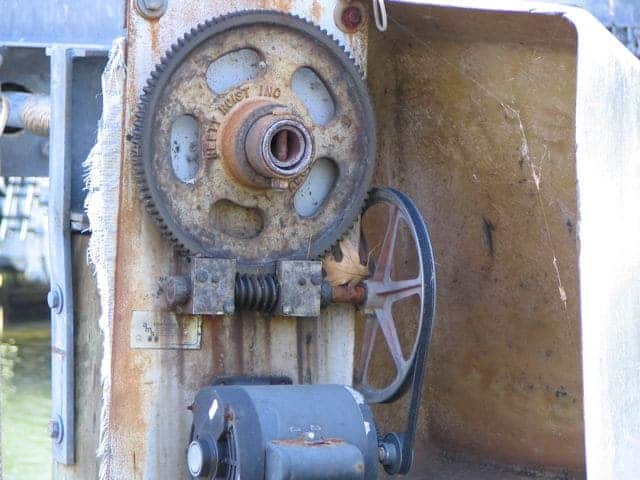
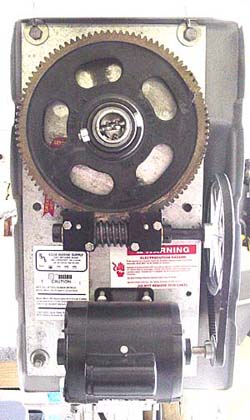
Gearbox and Drive Units – Check all gears monthly and make sure they are well greased.  You do not want to have a drive unit seize because there wasn’t enough grease.  If you have a flat plat drive, remove the covers and check to make sure that the belts are not loose, broken or frayed.  If any of these signs are visible, it is strongly recommended that you have the belts replaced immediately.  Also, check the alignment of the belt and adjust if necessary.

Typical flat plate drive.


Examine the motors for signs of rust, paying special attention to the capacitor cover.  If the motors are not under a cover, look to see if the motor is retaining water.  Make sure the top-side drain holes are closed and the bottom-side drain holes are open to keep out debris and allow proper drainage.  High-quality American made motors typically last 7-10 years when under a cover.  It has been our experience that Chinese made stainless steel motors last 1-2 years when exposed without a cover.


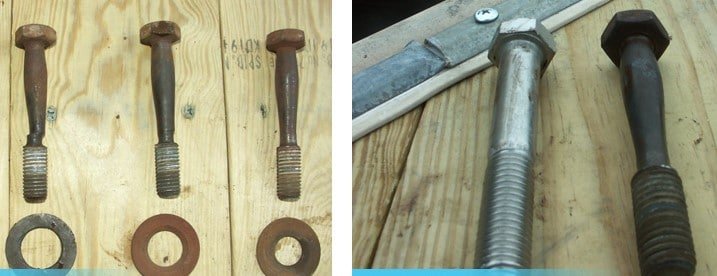
Pulleys – Be sure to check your sheaves (pulleys) for grease.  If the sheaves and bolts are not greased every 4 to 6 months (depending on use) the friction between the sheaves and the sheave mounts will increase, causing the sheaves to squeak and eventually seize up.  Be sure to check the nuts and bolts and make sure they are nice and tight.  One loose bolt could cause havoc.

What happens to sheave bolts without proper lubrication. New vs old bolt.


Drive Pipe Bearing Block – Every 4 to 6 months, make sure to grease all of your grease points so your motors are able to operate at their optimal performance.  Lack of grease causes more friction between the drive pipe and bearing which will increase the potential for failure.  If your bearing blocks are bolted to the top beams, make sure all the nuts and bolts are tight.


Wired Zincs – If you have an elevator style lift, confirm that the wired zincs are submerged underwater at all times.  Inspect the zincs and replace if they are more than 50% worn.


Maintenance Instructions for IMM Quality Boat Lifts

IMM Quality Boat Lifts prides itself on building extremely durable and low maintenance lift systems.  We use higher quality materials and maintenance-free components to save you time and money.  Please refer to the Owner’s manuals for more detailed instructions for your specific lift.  Here are a few helpful tips to ensure your boat lift is working properly and to prolong its life.

Lift Cables – Follow the general procedures for any boat lift described above.

Lift Beams – Follow the general procedures for any boat lift described above.

Bunks – Our Platinum and Superlifts come with aluminum bunks covered in non-marring white vinyl.  Our UV resistant bunks are guaranteed not to float and are covered by a 10 year warranty against tearing, fading, mold and corrosion.

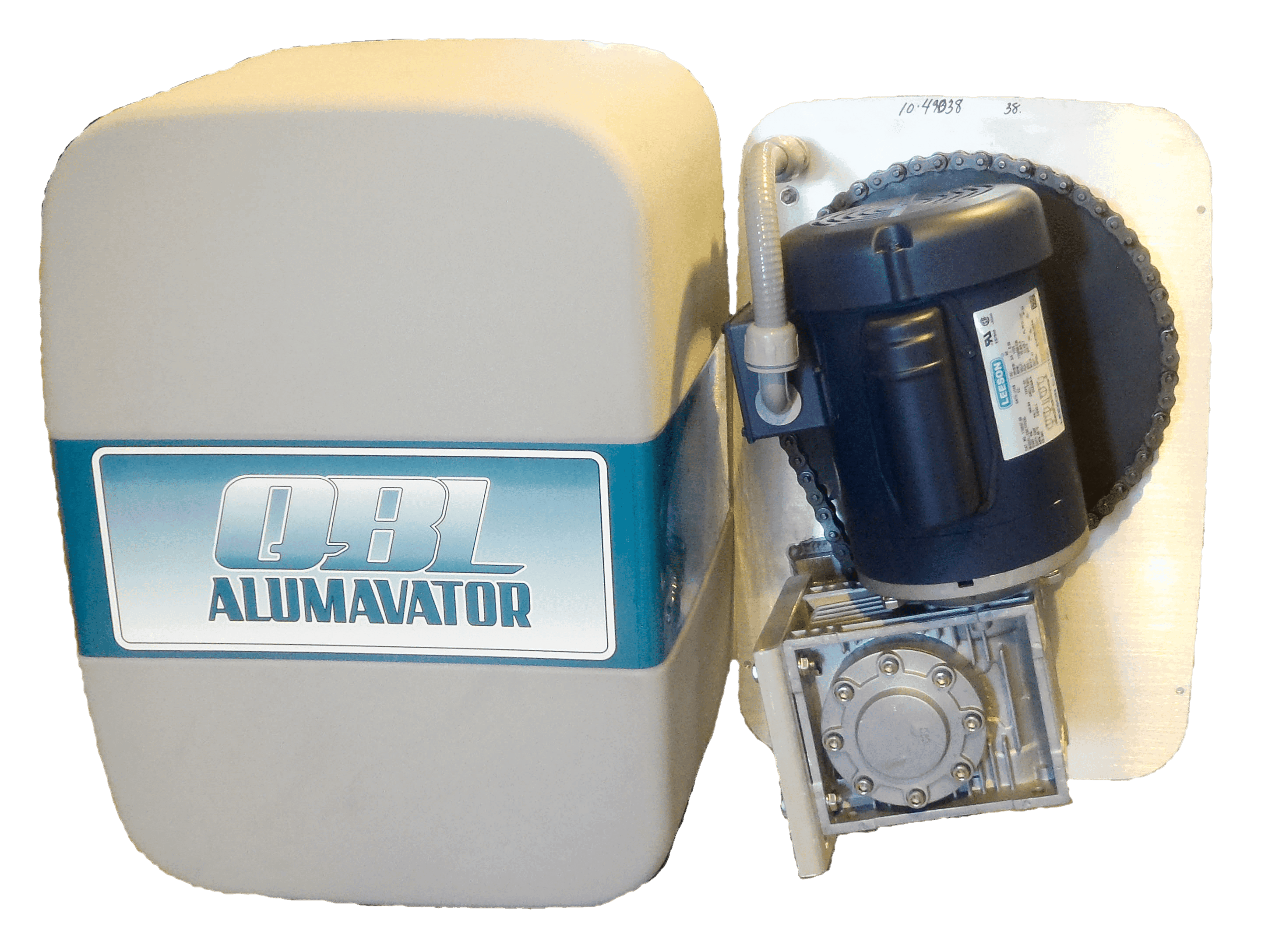
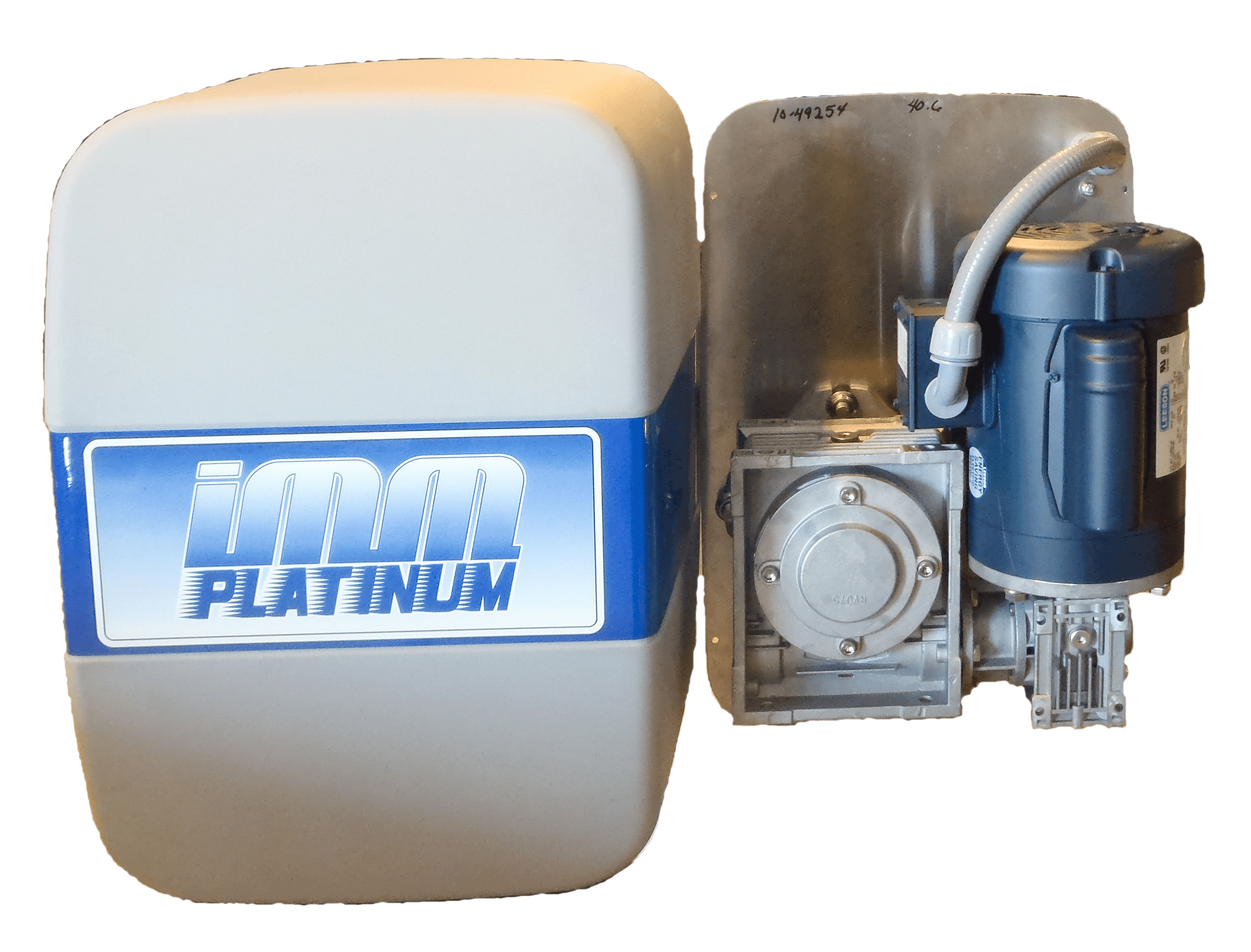
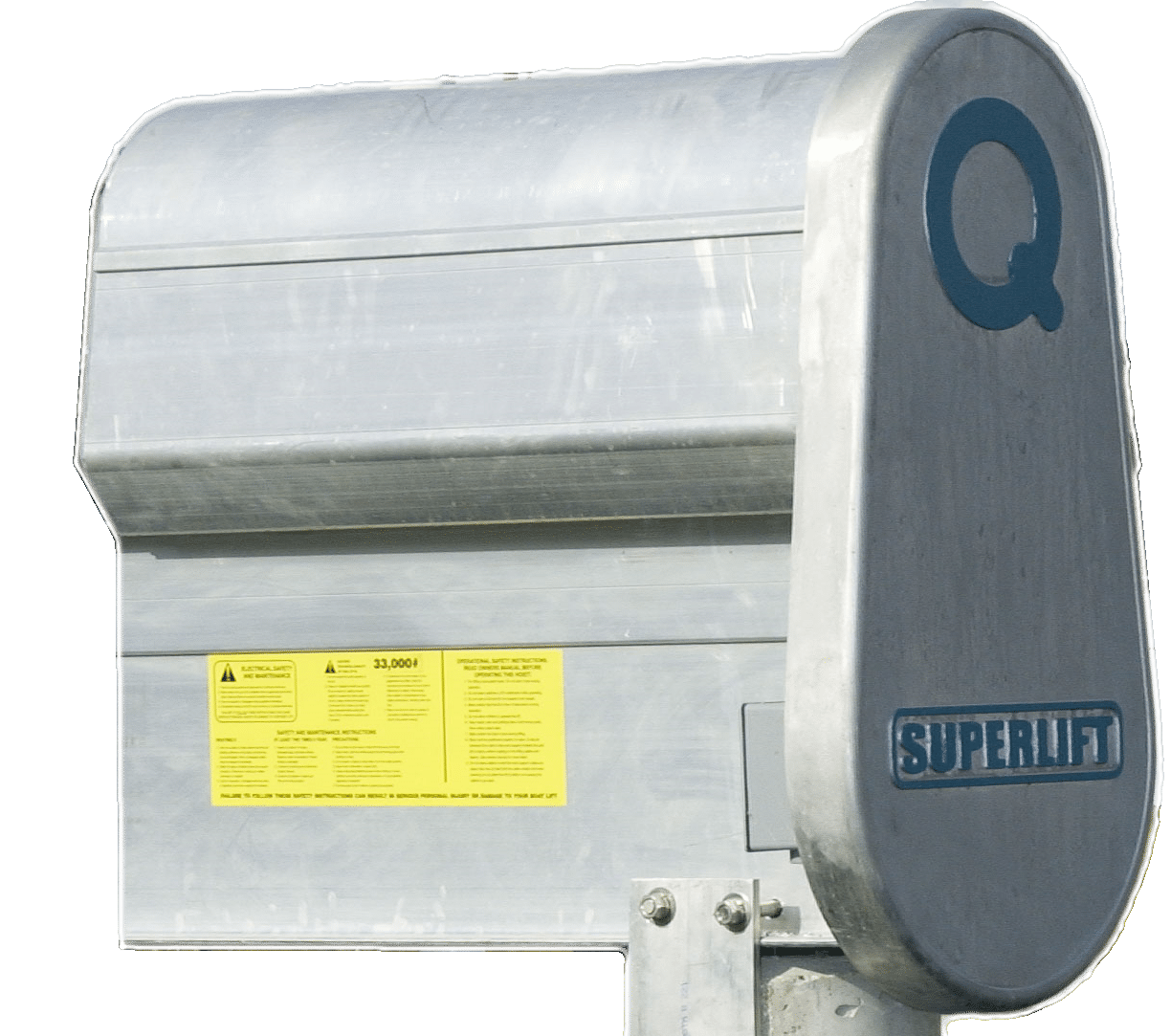
Drive Units – On the Alumavator chain drive and Superlift, either remove the cover or use the access port on the back plate to lubricate the chain and sprocket with roller chain lubricant (ie. Schaeffer’s #227 Moly roller chain lube) every 6 months.  The Platinum drive system is maintenance-free.  No adding or changing lubrication is necessary.  None of our drive systems have any belts to adjust or replace.  All of our drive systems have covers, so no maintenance of the American made motors is required.

Pulleys – On all our lifts, our pulley bearings are maintenance-free, no lubrication is necessary.

Drive Pipe Bearing Block – On all our lifts, our drive pipe bearings are maintenance-free, no lubrication is necessary.

Wired Zincs – Follow the general procedures for any boat lift described above.


Following these helpful tips will ensure that you will get the most life out of your boat lift, help you save money and enjoy more time out on the water.  If you don’t have the time or would rather leave it up to someone who knows all about boat lift maintenance, we have a friendly, knowledgeable service department who will be more than happy to answer questions and put you in contact with a local service provider to make sure your boat lift is running at its peak performance.  Give us a call today at 800-545-5603.

How to Choose a Marine Contractor

Long row of IMM Quality Alumavator Boat Lifts at a multi-slip marina

How to Find the Best Marine Contractor

When it comes to your waterfront property, it is important to choose a marine contractor you can trust and who will respect your property.  Careful selection of a knowledgeable and reputable marine contractor will often determine the quality and success of the project.  It is critically important to choose an experienced contractor with expertise in the type of project that you intend.  Some preliminary research into marine contractors will ultimately help to ensure the success of your marine construction project. First, one should obtain and read educational materials concerning the type of marine construction project to be performed.  In addition to searching the web, publications addressing a variety of marine construction projects are available from Sea Grant and the U.S. Army Corps of Engineers.  Once you have obtained sufficient background information, write down as much as possible about what you intend to have accomplished by the project.  Knowing what you want ahead of time can help eliminate expensive midstream changes.  You should describe the current condition of your property, clearly state how you would like your property to be improved, and specify any preferences for type of construction and final appearance.  Potential contractors should be given as clear a picture of the project as can be provided, but should not have preconceived solutions presented to them.  You will be best served if the contractors are free to propose a range of feasible designs from which you can chose a final project. Next, you need to identify potential marine contractors that serve your area.  Some, but not all, marine contractors are in your local listings.  Others have web sites on the Internet.  You can also find marine contractors through their professional associations.  For example, the International Marine Contractors Association (www.imca-int.com/), the Marine Contracting Network (www.marinecontractingnetwork.com/) and various state marine contractor associations (eg. Florida www.myfmca.org/, Maryland www.mdmarinecontractors.org/, etc.) all have excellent lists with contact information.  However, one of the easiest ways to obtain names of potential marine contractors is to walk the shoreline by your home.  Existing projects should be inspected and discussed with the owners.  Ask the homeowner if the contractor had the proper equipment to successfully complete the project, if there were there any unusual problems during or subsequent to the work, how long ago was the project completed, is the owner satisfied with the way it has performed and would they use this marine contractor again. After several companies have been identified that perform the sort of work being proposed, contact them and provide the details of your project.  Each company should be invited to personally inspect the project site.  Allow ample time for them to adequately review the project, present their company’s capabilities and for you to ask questions.  Questions should be asked about price ranges for the various possible solutions, but the company representative’s should not be told how much you have budgeted for the project.  Have the company provide a list of similar marine construction projects that they have completed.  If possible, visit these projects and speak with the owners.  Reputable contractors will usually submit preliminary design specifications along with a price estimate for your consideration shortly after the initial site visit After carefully reviewing the plans, ask the contractor to explain the rationale for the proposed designs and the use of the proposed materials.  Answers to these questions can provide useful insight into the contractor’s training, experience, and knowledge of marine construction.  The choice of materials is critical, cutting corners can severely shorten the life and safety of your structure, but you also don’t want to be oversold on materials and features that exceed what your situation requires.  Make sure to have the contractor fully explain what the estimate is based upon so that you are not surprised with hidden costs part way through the project.  An alternative would be to have the project designed by a professional engineer and let the contractors submit bids based on those specifications.  Although this would be more costly, it would make sure that all the estimates are figured on the same design. Your selection of a company should take into account the contractor’s experience, reputation, special qualifications, personnel available, time schedule, and grasp of the project and any related problems.  Look at the materials proposed for use, the design specifications, and the quality of service being offered.  A poorly designed / constructed structure could require repair sooner than a better, more expensive project, resulting in greater long term costs.  Make sure to get a written contract that is signed by both yourself and the contractor.  Although this process requires extra time and effort, it is the best way to ensure a long lasting finished product.

Good Questions to Ask When Interviewing a Marine Contractor

  • Are you licensed? Ask to see a copy and check with local licensing agencies.
  • Are you Insured? Contractors should have commercial marine liability and workers compensation policies.
  • Are you bonded? Ask for proof and be sure of what is covered.
  • How much will the project cost? Get the cost of the project in writing, make sure it is detailed with supplies and time frame broken down.
  • Will you do all of the work or will there be subcontractors? You want to be sure who is coming to your jobsite and that they are as reputable as the primary contractor.
  • Ask for references. Make sure to contact former clients.  Ask for their experience with the contractor.
  • How can I get in touch with you? It is important to get a physical address along with business and cell phone numbers. The more ways you can connect the better.
  • Is a permit required for installation of a dock or seawall?  It is best to check with local authorities, and even the Army Corps of Engineers, before starting a project.
  • How are the pilings set? Do you water jet them or use a friction crane?
  • How are you attaching the deck boards to the framework?
  • Who does the electrical?
  • Do you wrap the pilings to prevent damage?

Potential Red Flags to Look Out For

  • Wants all costs paid up front or accepts only cash.
  • Provides references that can’t be verified.
  • Avoids putting bid in writing or providing a written contract.
  • Bid is exceptionally low – if it seems too good to be true, it probably is!
  • Asks you to obtain building permits.
  • Uses high pressure sales tactics, such as special pricing contingent upon signing a contract that day.

Frequently Asked Questions (FAQs) about Choosing a Marine Contractor:

A marine contractor is a professional specializing in the construction, installation, repair, and maintenance of marine structures, including docks, seawalls, and boat lifts. Choosing the right marine contractor is crucial to ensure the safety, quality, and longevity of marine projects.

When choosing a marine contractor, consider factors such as their experience, reputation, licensing and certification, insurance coverage, portfolio of past projects, customer reviews, and adherence to safety standards and regulations.

Experience indicates the contractor's level of expertise, knowledge, and proficiency in marine construction projects. A contractor with extensive experience is better equipped to handle challenges, make informed decisions, and deliver high-quality results.

 Yes, it's essential to verify that the marine contractor holds the necessary licenses, certifications, and permits required to perform marine construction work in your area. Valid licensing ensures compliance with regulatory requirements and adherence to industry standards.

Insurance coverage protects both the contractor and the client against potential liabilities, accidents, property damage, and injuries that may occur during the construction process. Ensure that the marine contractor carries adequate liability insurance and workers' compensation coverage.

 Yes, reviewing the contractor's portfolio of past projects provides valuable insights into their craftsmanship, attention to detail, and the types of marine structures they have constructed or installed. Pay attention to the quality, durability, and aesthetics of completed projects.

 You can gauge the reputation and reliability of a marine contractor by seeking recommendations from trusted sources, reading online reviews and testimonials from past clients, and checking references provided by the contractor.

 Adherence to safety standards and regulations is paramount in marine construction to prevent accidents, protect workers and bystanders, and ensure compliance with legal requirements. Choose a contractor who prioritizes safety and maintains a safe working environment.

Buying a Boat Lift Direct

Buying a Boat Lift Direct is easy with IMM Quality Boat Lifts

Should I buy a boat lift direct / Do I need a marine contractor?

Can I do this myself?

There are a lot of places online from which you can buy a boat lift direct.  Please be very careful and do your research on these websites.  Do you know if they are re-sellers, wholesalers, or are they the manufacturer of the lift?  Where is the lift made and how is the quality of its construction?  Many of the dot com boat lifts are not made to the same standards as the reputable manufacturers whose lifts you have seen on the waterways.  FYI, a popular online boat lift company with US in its name has their lifts made for them in Thailand using substandard materials.  Shouldn’t they really be known as Boat Lift Thailand?  Also, if you buy direct, who would you contact if you needed service or had a warranty issue?  Who will install it? Please keep in mind that a boatlift is a piece of heavy equipment.  To ensure that your boat lift functions properly and safely, IMM Quality Boat Lifts recommends that the lift is installed by a licensed and insured marine contractor.  If you buy direct from the factory, will you really get a better price than through your local marine contractor?  It is customary to offer volume discounts to dealers, so that even after their markup, they are still cheaper than the price to an individual.  Will your local marine contractor install a lift that you bought direct?  If you find someone willing to install your direct sale, don’t be surprised if they charge a higher installation fee knowing they are not making money on the lift sale.  You may save a few hundred dollars upfront by purchasing a boat lift direct, but it could potentially cost you thousands of dollars in damage to your lift or boat, not to mention the safety of you and your family if it is installed improperly. At IMM Quality Boat Lifts, we pre-assemble as much of our lifts as possible to make the installation process straightforward, simple and easy (this is definitely not the case with other manufacturers).  That is why a lot of people look at our installation instructions and think they can do it themselves.  However, there are many reasons why you should use a licensed marine contractor.
  • A licensed marine contractor has the technical knowledge to assess the condition of your current seawall or dock and pilings. Your boat lift is only as sound as the underlying structure.  Using an existing structure that can’t support the combined load of the lift and your boat is a disaster waiting to happen.
  • Marine contractors have special, sophisticated equipment, such as barges, tugs, pile drivers, pumps, clamshell cranes, etc. They know how to operate the equipment, and have experience putting it to use in diverse situations.  This equipment can make all the difference in a quality installation.
  • The engineering and construction principles for land-based structures are not directly transferrable to marine construction. The environment, physical forces, and often the soil types and morphology of coastal locations require specialized construction materials and techniques be used in marine construction.  A licensed marine contractor will have this knowledge.
  • The installation of your boat lift may require a permit. A local marine contractor will be familiar with the requirements in your area and can greatly assist you in the process.
  • You can not underestimate the value of experience and the knowledge it brings. Some of our preferred contractors have installed thousands of our lifts.  If you want the best possible installation, choose a marine contractor with lots of experience installing boat lifts.
Buying a boat lift is a great idea and it will dramatically improve your boating experience.  We hope that you found this post informative and that we have shown you the potential problems of buying direct.  We also hope that we have convinced you to use a licensed marine contractor for your boat lift installation.  The convenience and peace of mind you will have knowing that your lift was installed properly and safely are invaluable. If you have any questions, or would like the name of a professional marine contractor in your area please call 1-800-545-5603 and ask for sales.

Frequently Asked Questions (FAQs) about Boat Lift Purchases and Installation:

It's crucial to research boat lift sellers thoroughly. Many online retailers may not manufacture their lifts to the same standards as reputable manufacturers. Buying from a reputable manufacturer or through a licensed marine contractor ensures quality construction, warranty support, and professional installation.

Lorem ipsum dolor sit amet, consectetur adipiscing elit. Ut elit tellus, luctus nec ullamcorper mattis, pulvinar dapibus leo.

Improper installation can lead to damage to your lift, boat, or waterfront property, posing safety risks to you and your family. Licensed marine contractors understand the unique challenges of marine construction and can ensure a safe and reliable installation.

Licensed marine contractors have the technical expertise, specialized equipment, and experience needed for marine construction projects. They understand local regulations, can obtain necessary permits, and ensure compliance with safety standards, providing peace of mind for homeowners.

Look for marine contractors with extensive experience installing boat lifts and a track record of successful installations. Contractors who have installed numerous lifts from reputable manufacturers are preferred, as they possess the necessary expertise and knowledge to ensure a quality installation.

For assistance in finding a licensed marine contractor in your area, please contact us at 1-800-545-5603 and ask for sales. Our team can provide recommendations and connect you with reputable contractors to ensure your boat lift installation is completed safely and efficiently.

All About Boat Lifts

Learn all about this marine boatlift by IMM Quality

Why buy a boat lift?

While no one can deny the fact that boat lifts offer waterfront homeowners numerous conveniences, “protecting my investment” remains the number one reason boaters invest in these home improvements.  After all, keeping your most prized possession above tidal fluctuations and well out of harms reach from wind, waves, marine growth, and corrosion from harsh saltwater is critical to the longevity of our vessels.

For waterfront homeowners, it is obvious that storing your boat on a lift offers a huge convenience factor.  For starters, you can forget about fighting the crowds at the launch ramp as well as the numerous headaches that go along with maintaining a trailer.  While tying up is easy, lifting your boat high and dry when not in use is even better!  Not only does the convenience of a boat lift improve your overall boating experience, boat lifts increase the value of your home and help maintain the value of your boat.  Furthermore, boat lifts make it easy to inspect your vessel with great detail; whether it’s for a safety check, routine maintenance or thorough cleaning.  Boat lifts allow you to reach all sides of the hull and visually inspect thru-hull fittings, transducers, trim-tabs and props.  Boat lifts make routine maintenance and docking a breeze.

While purchasing a boat lift may sometimes seem like a hefty investment, in reality, they actually pay for themselves over time.  Go ahead and calculate what it costs to haul-out your boat annually to apply expensive anti-fouling coatings, or the routine maintenance required to keep your trailer functional.  It is an industry fact that applying bottom paint automatically reduces the resale value of your boat by as much as 10-percent.  The bottom line is that boat lifts are relatively maintenance free and make your boating and fishing experiences much more convenient and enjoyable.

How to select a boat lift?

Much like the rest of the marine industry, the last decade has seen significant innovation in the boat lift market with more yet to come.  Options now exist to suit nearly every dock configuration, tidal range and type of craft.  While there are a wide range of manufacturers and styles available, if you do your homework you will certainly find the proper boat lift for your particular application.  Manufacturers usually categorize their products by weight capacity.  Other important considerations include the depth of water at the dock, length of your vessel, beam length, type of hull (deep-V/catamaran) and propulsion (inboard/outboard).  It is also important to remember that the dry weight listed for your boat is not your vessel’s total weight.  You must compensate for fuel, water, tackle and gear.  Vessels powered with outboard engines do not generally include the engine(s) weight in the overall displacement, so that must also be added in.

When you begin to investigate your boat lift options, the plethora of choices will likely overwhelm you.  The boat lift choices can be distilled down to a few basic types that you should consider; standard four pile beamed cradle lifts, elevator lifts and boathouse lifts.

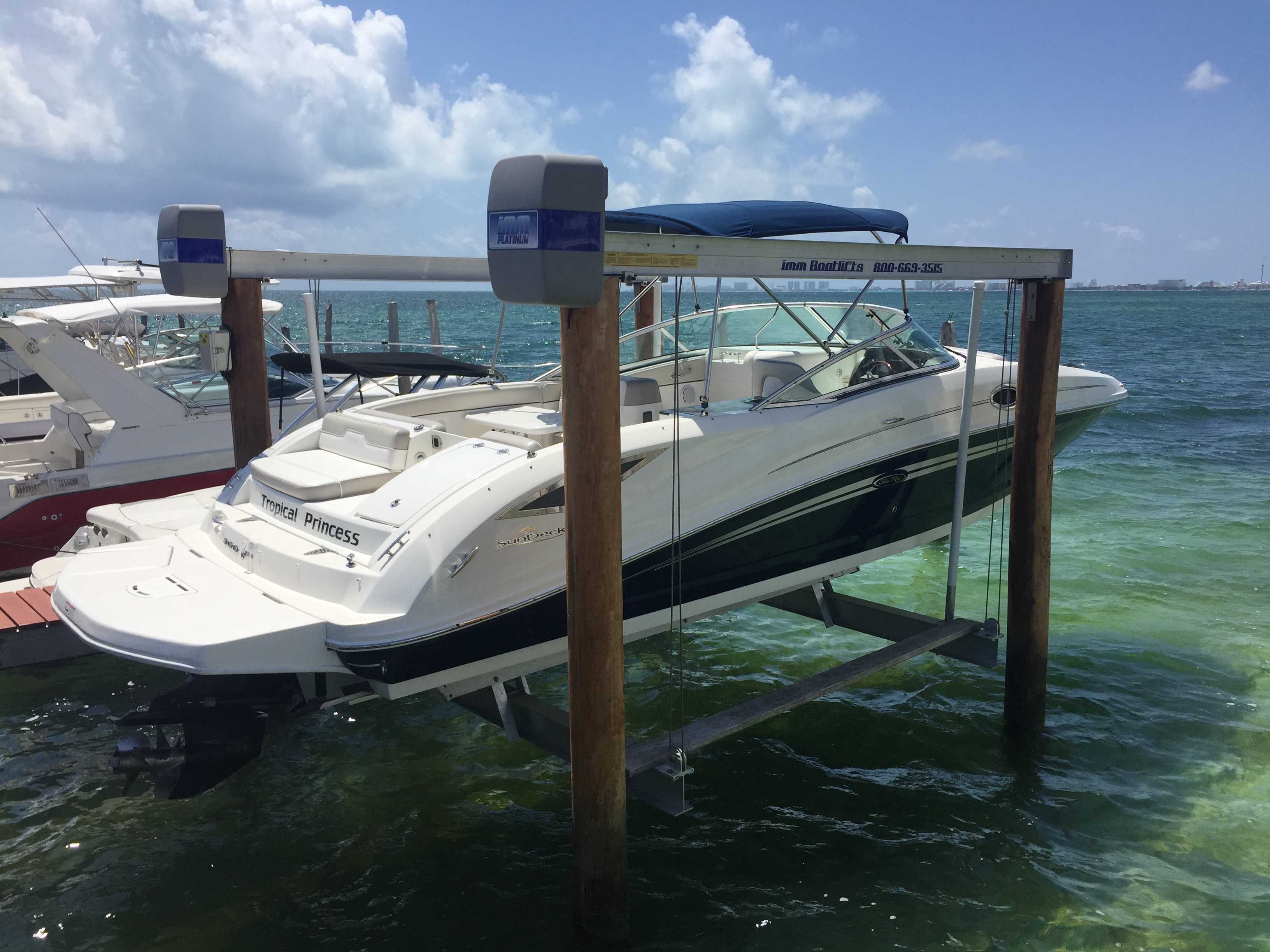
The four pile beamed cradle boat lift is currently the most efficient design for a cable drawn lift.  This type of lift was developed a couple of decades ago, and has become the industry standard.  It can be recognized by its parallel upper beams that each contain a motor driven shaft through their length on which four cables are wound.  The cables are connected to the four corners of the boat cradle, which is raised or lowered by clockwise or counter clockwise rotation of the shaft.  Four post lifts out-sell all other lifts combined due to the fact they are less expensive and are easier to maintain and install.  These lifts can be deigned to work with any sized vessel.   The “top beams” of these lifts can be set in a “low-profile” configuration, which allows you to use a covered top beam as a boarding platform for easy access to your boat.

Four Pile Beamed Cradle Lift

Elevator style lifts are another popular option and they are ideal for use on restricted waterfronts where outboard pilings are not allowed, such as on narrow canals, or where the driving of pilings is difficult due to hard bottom conditions.  Elevator lifts can be mounted on seawalls or pilings and in a vertical or inclined position.  Elevator lifts are available with capacities up to 30,000 lbs. and custom designs can accommodate larger vessels if the strength of the underlying dock / seawall structure is adequate.  The only drawback to an elevator lift is a higher price tag than four post lifts.

Elevator Lift
Elevator Lift

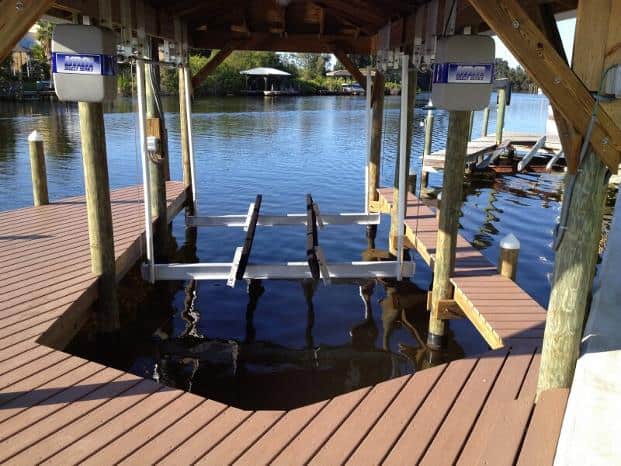
For homeowners fortunate enough to have a boathouse, adding a boat lift is a fantastic idea.  Traditionally, boathouse lifts were custom designed for each application where the top beams of a standard boat lift used special riser brackets that supported the boathouse rafters and roofing structure.  If you are considering building a boathouse with this style of boat lift installation, it is important you contact your intended boat lift dealer first to ensure a seamless installation.  As you can imagine, maintenance and repairs to your boat lift could be problematic with a riser bracket style of boathouse installation.  Even worse, if you decided to replace your boat lift, you would have to remove the roof of your boathouse to do so.  That is why the invention of hanger brackets has greatly improved the industry.  The hanger bracket assembly slides over the structural stringer bands of the boathouse.  Once in place, the hanger brackets are fastened to the structural stringer bands using stainless steel bolts that require no drilling of the bands.  The boat lift components hang from the bracket assembly with this style and can be easily maintained, repaired or replaced.  This makes hanger brackets the most effective way to mount a lift inside a new or existing boathouse.

Boathouse lift
Boathouse lift

Drive Types

Your next consideration, should be the drive system.  The venerable flat plate was introduced over 40 years ago.  This economical option has the slowest operational speed, it is very noisy, messy and is hampered by its belt drive.  The belt drive requires frequent maintenance and is prone to slippage and breakage.  The chain drive has largely replaced the obsolete flat plate drive.  The chain drive is an economical choice with good operational speed and high shock load durability.  The chain drive does require annual maintenance.  There are many types of gear drives available, but the most common use dual worm gears.  These gear drives are fast, do not require any maintenance, and now are more durable than the flat plate.  The downside is that they are considerably more expensive than flat plate or chain drives.  Another choice is hydraulic drives.  These drives are very fast, but they have been found to be extremely susceptible to saltwater corrosion, prone to hydraulic leaks, are complicated to maintain and they are extremely expensive (generally double the price of a gear driven lift of the same capacity).

flat plateAlumavator PowerheadPlatinum Powerhead

                    Flat Plate                                   Chain Drive                                           Direct Gear Drive

The previous styles of drives all rely upon extremely inefficient gearing (or hydraulic pressure) so that they can save money by not having a brake on the lift.  Kind of scary, but it works.  The final type of drive, the cycloidal drive, is different from the rest because it is extremely efficient (greater than 95% for cycloidal drives compared to approximately 35% for the others).  The high efficiency results in very fast lift speeds, even faster than hydraulics, but it requires the use of fail-safe brakes, which adds to the cost of the lift.  Cycloidal drives are also gearless, so they don’t have any gears to grind together, wear down, lose teeth and lock up.  Consequently, cycloidal drives have legendary durability and come with a lifetime guarantee.  Cycloidal drives are also the most powerful drives in the industry.  One manufacturer claims their gear drives are the most powerful in the industry with 8,000 in. / lbs. of torque, but cycloidal drives with 34,000 in. / lbs. of torque are routinely used on boat lifts and cycloidal drives with up to 521,000 in. / lbs. of torque are available to use on mega yacht lifts.  Although they are less expensive than hydraulic drives, the major drawback to cycloidal drive systems is that they are more expensive than the other drive systems.  However, if only the absolute best will do, and you want the fastest, most powerful and durable drive system, the cycloidal drive is the only choice.

Cycloidal Drive
Cycloidal Drive

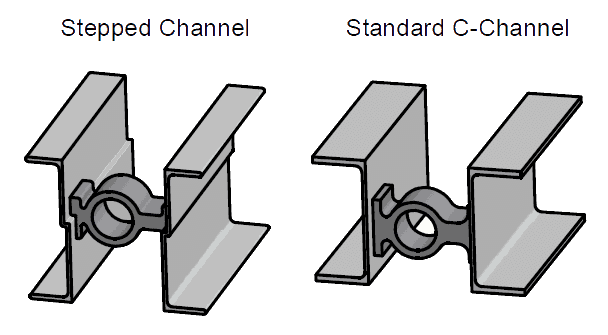
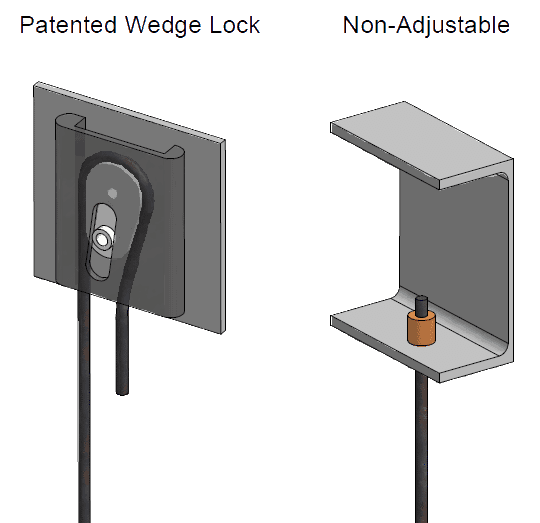
Finally, you need to consider the other components on the lift to see if they will make your boat lift easier and more convenient to use.  Does the lift use pulley and drive shaft bearings that require lubrication?  Do you really want to climb out onto your cradle and top beams, find the zirk fittings and grease up your drive shaft and pulley bearings every 3 months, or would you rather have a lift with maintenance-free self-lubricating bearings?  Would you rather have a lift that uses cables with fixed ends that can’t be adjusted once installed and must be cut off and repaired during cable replacement?  Or would you prefer a lift with wedge locks that allow for easy adjustment of cable length to level the cradle, adjust the pitch of the boat and make cable replacement easier?  Do you want a lift designed with cable keepers or cable rollers to ensure proper cable winding and extend cable life?  Do you want your top beams made with stepped channel which provides structural support for the drive bearing blocks and eliminates shear loads on the weld?  Or would you prefer your top beams be made from standard C channel with the entire load held up by the weld?  Do you want wood bunks or aluminum bunks?  Does the manufacturer use UV resistant non-marring white vinyl that requires no top-side rivets or do their bunks use black plastic with top-side rivets that can mar and scratch your hull?  Is the lift made from aluminum or galvanized steel?  Due to recent changes in EPA guidelines, the galvanizing compound now scratches off easily and galvanized steel lifts will quickly corrode.  Aluminum will not corrode, but it is more expensive than steel.

Bearing blocksStepped vs regular channelWedgelock

Conclusion

All in all, boat lifts are extremely valuable.  They only account for a small percentage of your overall boating expenses, yet they greatly reduce maintenance while simultaneously increasing safety and the value of your property.  If you have any questions, please contact the sales team at IMM Quality Boat Lifts and they can help you choose the right lift for your home.  You’ll be glad you did.

Why Buy a Boat Lift?

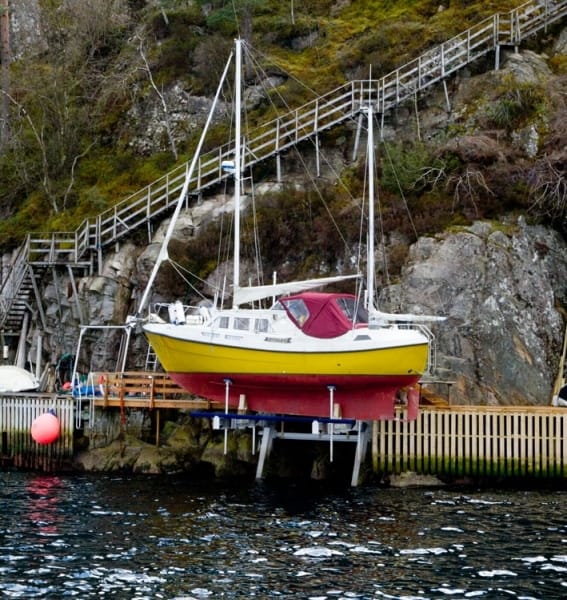
Red and yellow sailboat in Norway is lowered into the water using an IMM Quality elevator boat lift

Many new (and some old) boat owners often wonder what the purpose of a boat lift is.  Is it truly necessary to have a boat lift?  There is definitely no argument that constant contact with water can lead to a number of issues, but an outstanding boat lift can help to counteract each of these.  Let us explain a few of the reasons why it is so important to buy a boat lift to keep it as a dry-dock.

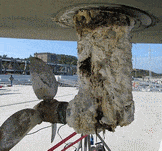
1)  Watercraft left in the water quickly become fouled.

As anyone who has ever pulled a boat from the water after several days can attest, aquatic life takes little to no time to attach itself to a boat or other watercraft.  Whether it is fouled by sea growth, muck, barnacles, algae, zebra mussels, crustaceans or any number of other forms of marine life, each of these can quickly damage a boat, decreasing the performance of the watercraft.  In ALL cases, chronic water storage significantly decreases the life and value of the watercraft.  This is the primary reason for the application of anti-foul paint to a ship’s hull.

Fouled hull

Unfortunately, before this paint can be applied, the hull will typically need to be pressure washed, scraped and then sanded.  As you can imagine, this requires removing the boat from the water.  By keeping your boat on a lift, you will help to decrease the likelihood that aquatic life will be able to affect your hull.  This means a whole lot less washing, scraping, sanding and painting!

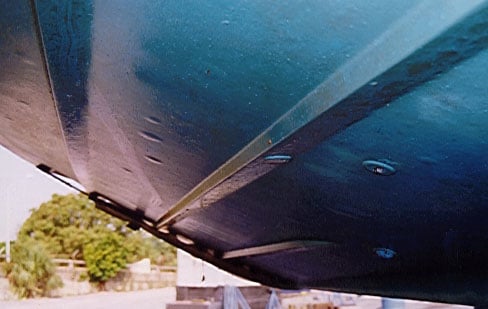
2)  Your boat will absorb water, causing staining and blistering.

Storing a boat in the water may not seem like a bad idea, but it is truly damaging to the boat.  Some of the effects are merely cosmetic (hull staining), while others pose a threat to the boat in more significant ways.  Most boats have areas that are porous, like the fiberglass and resin structure.  As fiberglass hulled boats remain immersed, osmotic pressure causes water to seep underneath the gel coating.  This can lead to blistering and eventual delamination of your fiberglass hull.  As you can imagine, this sort of damage can be more than just expensive to repair.  Many times it can mean the end of your vessel!

Hull blisters

So, what can be done to prevent blistering and hull delamination?  First, before purchasing your boat, check to see which type of resin has been used.  A builder’s specific choice of resin may help to deter blisters.  Second, apply a barrier coat.  Usually an epoxy, or similar material that seals out the moisture, is better than a polyester gel coat.  As you may have realized, one of the keys in keeping the barrier coat intact involves reducing the need to sand the hull for the application of anti-foul paint (discussed above).  Each time you take steps to reapply anti-foul, you actually end up hurting the barrier coat itself.  Finally, you should reduce the amount of time that your boat stays in the water.

Depending on the boat you have and the investment you made, you may or may not be concerned with cosmetic blemishes.  However, most boat owners take great pride in their watercraft and want it to remain as pristine as possible.  Furthermore, blistering and hull delamination seriously decrease the safety of the vessel.  In the end, your best defense against blistering is to be a good boat owner and invest in all of the proper precautions.   Storing your boat off of the water on a high quality lift will help to reduce time consuming maintenance and will reduce the likelihood of damaging your barrier coat.  In addition to being a time saver, using a boat lift also will help to maintain the appearance of the boat and improve its resale value down the road.

3)  Vessels left in the water have increased damage from corrosion and electrolysis.

Your hull isn’t the only part of the watercraft that will have to deal with the ramifications of constant contact with the water.   A great deal of the metal parts on your vessel may also be at risk for damage.   Corrosion is the gradual destruction of metals through electrochemical oxidation, commonly known as rusting for iron.   Electrolysis is the chemical decomposition produced by passing an electric current through a liquid or solution containing ions.  Electrolysis, which occurs to most metals, can lead to extensive damage when a boat is left in the water for extended periods of time.

corrosionelectrolysis


Imagine pulling your boat from the water only to find metal fittings, props, and more all but eaten away.  Even worse, the same sort of damage can take place inside your engine block, manifold and pumps as well.  This sort of damage can be extremely bad as you can’t typically see it until your boat simply breaks down.  The use of special anodes can help offset this to a degree; however, the best means of preventing it is through the use of a boat lift.  This will give your boat the time out of the water it needs to keep the damage to a minimum.

4)  Save time to get in and out of the water.

In addition to preventing corrosion and damage to your boat, the use of a boat lift will also save you time and make your time on the water more enjoyable by making it easier to get your boat in and out of the water.  Proper dry-docking on a boat lift also greatly enhances access to the watercraft for boarding, fueling and maintenance.  Depending on where you are located, you may experience fluctuations in water levels.  These can be major or minor instabilities, but they will most certainly have an impact on your boat and your ability to get your boat in or out of the water.  When using a boat lift, however, you can feel secure in the fact that your watercraft is resting securely, no matter the level of the water.  When it is time to be underway, simply lower the lift into the water and drive away.  You can not underestimate the convenience a boat lift will bring and how much of your valuable time you will save by not having to constantly drag your boat out of the water the old-fashioned way.

5)  Prevent damage to your watercraft due to inclement weather.

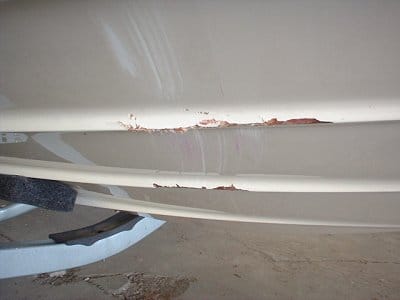
hull damage

Protect your investment!  Watercraft dry-docked on a boat lift do not need lines or bumpers.  Boat lifts prevent the watercraft from hitting the dock during heavy wake or inclement weather, avoiding scrapes and bruises from bouncing around in a tied-off wet slip mooring.  When properly configured, a boat lift can dry dock your vessel well above storm surge.  Also, the Boat Owner’s Association of the United States recently took a look at insurance claims and found that 69% of boats sink at the dock or mooring.  With a boat lift you do not need to constantly worry about your bilge pump.  If your bilge pump fails while you are away, your boat is still safely dry-docked with a boat lift.

Conclusion

No matter how large or small your boat is, it is a true investment that needs to be protected.  When you buy a boat lift from Imm Quality boat lifts, you are taking the necessary measures to protect your investment.  In addition to building the finest, most reliable lifts, our full-service engineering department is unique to the industry.  We have made numerous innovations and have generated more patents than all other boat lift manufacturers combined.  Our lifts are the most advanced designs on the market.  From personal watercraft to full custom designs for the largest yachts, our customers can depend on our products being exceptionally engineered and thoroughly tested.

Don’t hesitate to contact us if you have any questions about our products or boat lifts in general.  We look forward to helping you find the right solution for your docking needs!